The Death of SAAS (As We Know It)
The impact of AI on SAAS will look very different depending on the time horizon: a near-term repricing of software economics, and a longer-term shift in what “applications” even are.
Much has been written lately about the “death of SAAS”. There are strong opinions around two extreme positions:
-- The futurists believe that as improvements in AI continue to accelerate, companies can rapidly “vibe code” their own applications, customized for their industry, data and workflows, and tuned to their specific needs. Thus:
- They no longer need as many SAAS seats, if any
- At best, SAAS applications represent the systems of record
-- On the opposite side, the continuity camp believes that SAAS players will continue to be key players in the Enterprise, due to a combination of these reasons:
- AI-coded software won’t be good enough (due to the risk of hallucinations, inaccurate outputs, etc.)
- The software itself is just one part of the offering; what SAAS companies really offer is the complete solution
- Customers will not want to build this type of software themselves, as it is not their core competency
The financial markets, for their part, have already repriced risk across many software names, albeit from stratospheric levels.
A Tale Of Two Timelines
I think the continuity camp is right that it is unlikely that companies will choose to build all of their own software themselves; most IT teams are already perennially backlogged. And companies do indeed want complete solutions, not just intelligence and problem solving.
But the futurists are also right in thinking that “AI is eating software”, just as we once heard that software was eating the world.
There is, however, a middle ground that I see as more likely to happen: SAAS doesn’t vanish in the next few years, but its economics get structurally worse.
The mechanism is simple: when the cost of turning intent into working software collapses, the scarcity that used to protect margins collapses with it.
Near Term: Margin Pressure
From personal experience, I’ve seen that the software being developed by AI models is increasingly more accurate and models are being instructed at higher levels: from code completion to design and technical architecture to business goals. If that trend continues, the differentiating value of the code itself will progressively tend towards zero. Small, thoughtful product-dev teams will be able to develop coding solutions in record time.
In that world, the primary value a software company provides is domain knowledge, integrations, workflows and training; i.e. ways to leverage the software product, rather than the product itself. This begins to look more like consulting economics: lower margins, higher customization needs, and lower capital leverage for scaling - making it difficult to generate SAAS-like returns.
In other words, the ability to develop software faster and at lower cost using AI will significantly erode margins over time; generalized solutions will be easily copied and bespoke solutions won’t be as profitable. Even if customers themselves don’t develop their own solutions, others will; these hyper-specialized, efficient companies will be much leaner than the current SAAS incumbents that suffer a significant level of bloat.
Which means that the terminal value of these SAAS companies is dramatically lower than the expectations that have been taken for granted over the past few years. Perhaps the market is right after all.
That’s the near-term story: cheaper creation and faster imitation compress margins and terminal values. The longer-term story is stranger and more consequential: what if “applications” themselves stop being the primary way humans get work done?
Long Term: Vanishing Applications
The idea of using AI to rapidly develop SAAS-like applications simply applies this radical new technology to the current paradigm; it’s like trying to develop a faster horse, rather than invent the automobile.
Instead, here’s a thought exercise: what if we didn’t need applications at all?
To be clear, humans will still need to interact with software: to give instructions, ask questions, receive reports and act on them, implement workflows and so on. But what if that interaction took a radically different form? Instead of the traditional primary interface - “open an app, click around, fill out forms” - what if it was multimodal agent interaction and delegation to agents?
A lot of today’s software artifacts exist because humans have to design, build, and operate systems in ways humans can understand: UI screens, navigation, explicit workflows, integration contracts, and database schemas. These abstractions are helpful, but they’re also clunky and leaky.
If autonomous AI systems develop to the point where they can reliably accomplish end results, then many of these abstractions become invisible.
To put it another way: features like data persistence, identity, permissions and auditability still need to exist. But instead of database-first thinking or UI-first thinking as the center of gravity, the new center becomes: intent → delegated execution → verified outcome.
Welcome To The Future
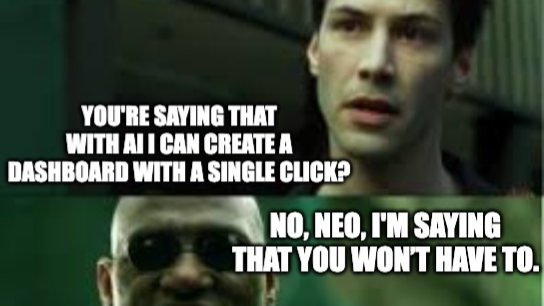
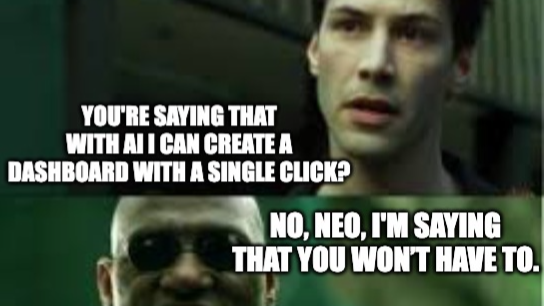
Let's outline a possible scenario: A VP of Sales in a company wants to evaluate the impact of an upcoming promotional campaign on sales within a given region. She asks her AI assistant: “If we run a 15% off promotion in the Northeast for two weeks, what happens to revenue, margin, inventory risk, and churn? And what should I watch daily?”
The assistant doesn’t “open the sales app” or “build a dashboard”; instead the work is delegated to an internal AI system that has governed access to the company’s data: transactions and costs, inventory and supply constraints, customer segments, pricing history, pipeline notes, and call transcripts; plus company policies about discounting and margin floors.
The system runs several paths in parallel: baseline forecast, promo uplift scenarios, cannibalization risk, capacity bottlenecks, competitor response assumptions, and a sensitivity analysis on margin and stockouts. It returns a concise answer with ranges and confidence levels, a one-page exec overview, a recommended plan and a daily monitoring brief. As a follow up, the assistant can initiate workflows with Finance, Supply Chain and Sales - all with an audit trail of what was recommended, what was approved, and what was executed.
Here’s the thing: the primitives to achieve this vision are already available in today’s tools. The hard part isn’t inventing a new form of intelligence; it’s productizing reliability, controls, security, evaluation, and trust so executives can delegate real decisions and actions without losing governance.
And nowhere in this scenario does the primary experience involve: (a) UI forms, with navigation, buttons and clicks, (b) explicit workflows or (c) SQL/NoSQL databases.
Systems of record don’t vanish. But they recede into the substrate.
And THAT is the real threat to SAAS incumbents.