The GenAI Adoption Pattern For B2B That Nobody's Talking About
Adoption of Generative AI into Enteprise B2B companies follows common patterns and takes longer than one would expect.
Introduction: From Shadow IT to Ecosystem Play
Much like the worldwide web before it, Generative AI is creating a fundamental shift in how technology companies operate and compete. But unlike previous technology waves that required deliberate adoption decisions, GenAI is already inside most organizations, brought in through the side door by individual employees experimenting with ChatGPT, Claude, Perplexity or Copilot.
While every industry is grappling with AI, the patterns are particularly clear in B2B software companies, where the transformation is happening at every level from individual developer productivity to enterprise AI strategies.
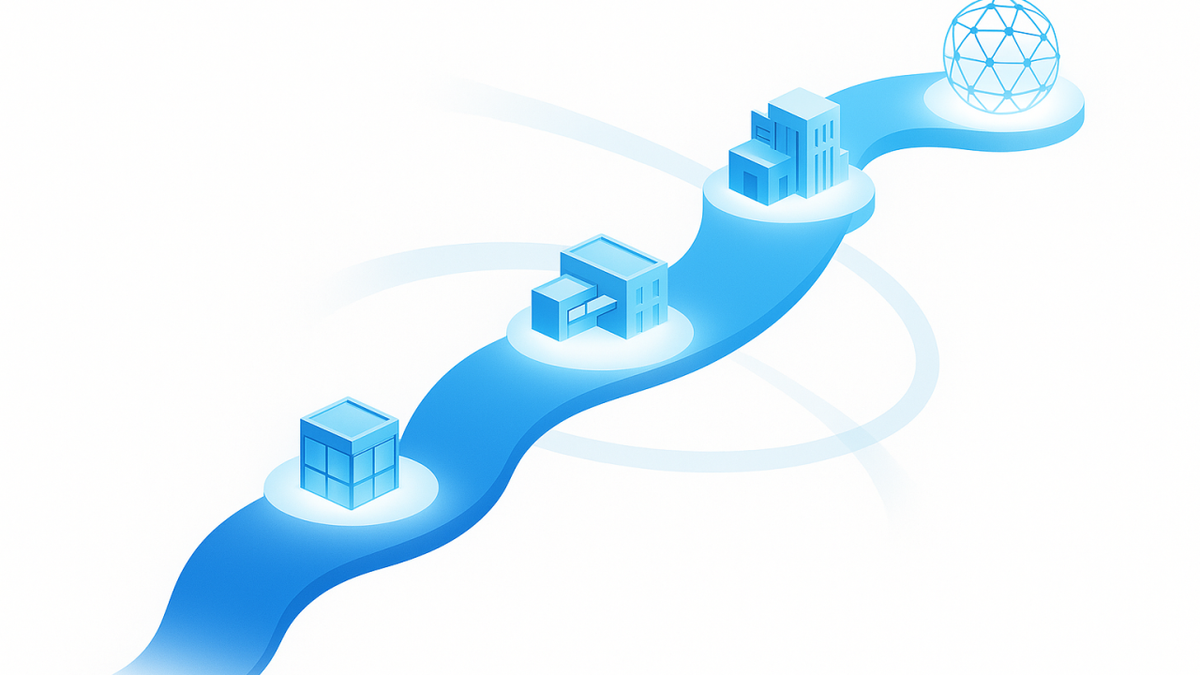
What's fascinating is that despite the disorganized nature of this bottom-up adoption, a surprisingly consistent pattern is emerging. GenAI adoption naturally evolves through four distinct stages:
- Individual Augmentation - Employees using AI as a thought partner for daily work
- Departmental Transformation - Functional teams adopting specialized tools (with software development leading the way)
- Product Integration - Companies embedding AI capabilities into their core product offerings
- Ecosystem Participation - Software products becoming part of customers' AI initiatives
These aren't random categories - they represent a maturity journey that we're watching unfold in real-time. Companies don't necessarily progress through them sequentially, but success at later stages often depends on lessons learned from earlier ones.
What makes this journey particularly interesting is how each stage carries its own rhythm of urgency. Some are happening whether leadership acknowledges them or not, while others are becoming competitive necessities. And the advanced stages are still emerging, offering early adopters significant advantages.
Let's examine what happens at each stage of this journey.
Stage 1: Individual Augmentation - The Thought Partner Phase
This stage is already well underway, whether organizations have officially sanctioned it or not, and companies need to acknowledge this reality. Tools like ChatGPT and Claude are universally accessible, with no specific training needed; anyone who can write a question can extract value. Knowledge workers across every function are using them to accelerate their daily work - from drafting emails to debugging code to creating strategic plans.
The risks cluster around security (data leakage through consumer tools) and accuracy (hallucinations), with most organizations responding by moving to enterprise licenses while users learn through experience what outputs to trust.
The costs remain bounded - predictable per-user licensing fees - while the value emerges from hundreds of small productivity gains accumulating across the organization.
Notably, companies don't "complete" this stage and move on; individual augmentation becomes the foundation that continues expanding even as they build toward departmental and product initiatives.
Stage 2: Departmental Transformation - Specialized Tools Take Hold
At this stage, entire departments adopt AI tools designed for their specific functions. Legal teams use research analysis and document drafting tools like Harvey.ai, customer service departments use Intercom’s Fin, an AI customer service agent that actually resolves tickets, and so on. But the clear leader - the most mature and effective use case at this point - is software development, where tools like Windsurf and Claude Code don’t just provide suggestions any more; they're becoming how code gets written.
The urgency here is competitive. Teams using these tools are shipping faster and handling more complex problems than those without them. AI isn't a magic pill - employees remain responsible for validation and quality - but the efficiency gains are too significant to ignore.
The risks at this stage expand beyond individual data leakage to include process dependencies, vendor lock-in, and the challenge of rapid obsolescence as new tools emerge monthly. Costs become more variable and significant than individual licenses, but they're still controllable through vendor selection and usage policies. The real challenge is change management - helping entire teams adapt their workflows around AI assistance while maintaining quality standards.
Stage 3: Product Integration - AI Becomes Core Functionality
"Powered by AI" is rapidly moving from differentiator to table stakes. At this stage, companies embed GenAI directly into their products - not as a cosmetic chatbot overlay, but as core functionality that couldn't exist without it; e.g. intelligent document processing, automated agentic workflows, and context-aware recommendations.
The urgency feels less immediate than earlier stages, but its importance can't be overstated. Products without AI capabilities are starting to look dated, like websites that never went mobile. The competitive dynamics are stark: once your competitor's product can understand unstructured inputs, generate insights automatically, or adapt to user intent, feature parity becomes impossible without AI.
The complexity jump from Stage 2 to Stage 3 is significant. Now you're dealing with model selection, prompt engineering at scale, output validation, latency, cost management that can spiral with usage, and the challenge of non-deterministic behavior in production systems. Yet the ability to deliver functionality that seemed like science fiction just two years ago makes this transformation inevitable.
Stage 4: Ecosystem Play - Becoming Part of the AI Economy
The final stage represents a fundamental shift in how products are consumed. Instead of humans clicking through your UI, your product increasingly serves AI agents that query your APIs for context, data, and actions; e.g. your customer's AI assistant needs to understand your inventory or execute workflows through your platform. The product interface becomes less about visual design and more about programmatic accessibility and semantic clarity.
This stage feels nascent but its arrival may be swift. We're already seeing early examples: Salesforce agents pulling data from multiple SaaS tools, AI assistants booking travel by interacting directly with airline and hotel systems, and GPTs that orchestrate complex workflows across different platforms. Companies that recognized the API economy early gained huge advantages; the same pattern is likely to repeat with the agentic economy. The difference is that APIs were designed for developers; this new paradigm requires designing for AI consumption.
The challenges here are still emerging, but clear themes are developing: How do you authenticate and authorize AI agents? How do you price your product when an agent might make thousands of LLM requests? How do you handle the support burden when your customer's AI misunderstands your interface? The security implications alone - ensuring data boundaries when AI agents have broad access - require rethinking fundamental assumptions.
Conclusion: Understanding the AI Journey You're On
The GenAI transformation isn't waiting for anyone's permission. It arrived through individual experimentation, is expanding through departmental adoption, and will ultimately reshape how products are built and consumed. Recognizing this pattern helps explain what might otherwise feel like chaos - why your employees are already using ChatGPT, why your development team insists on Windsurf licenses, why your product roadmap suddenly needs an AI strategy, and why your enterprise customers are asking about API accessibility for their AI agents.
Companies aren't progressing through these stages sequentially. Some jump straight to embedding AI in products while still fighting shadow IT usage, while others build sophisticated departmental capabilities but hesitate to touch their core product. Yet there's a cumulative effect - lessons from individual use inform departmental deployment, whose successes shape product integration, and all of it prepares you for the emerging agentic economy. Skip too many lessons and you risk building on shaky foundations.
The velocity of change varies dramatically across stages. Individual AI use has already become baseline expectation. Departmental tools are racing through the same transition, with the gap between AI-enabled and traditional teams becoming undeniable. Product integration is today's competitive battleground. Ecosystem participation remains nascent, but early positioning now will likely determine who becomes essential infrastructure versus who gets disintermediated.
This journey is happening whether you've formally acknowledged it or not. Understanding where you are - and what's coming next - transforms reaction into anticipation.