Your AI Adoption Problem Isn’t About AI

[This article was originally posted on LinkedIn on Sep 10, 2025.]
Every B2B software company racing to implement AI today faces the same hidden challenge: their data architecture wasn't built for this. The systems that worked fine for deterministic software start breaking when AI enters the picture, creating an invisible wall that stops progress cold.
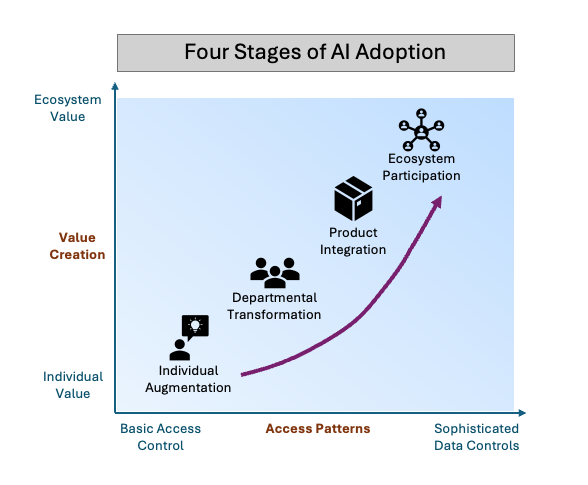
Some companies sail through the four stages of AI adoption while others get stuck. The difference isn't about AI strategy, it's about recognizing what is really happening beneath the surface.
In reality, these four stages aren't separate initiatives; they're the same fundamental data transformation revealing itself in different ways. Simple employee permissions required for individual use of AI evolve into complex multi-party agent interaction controls for participation in the data ecosystem. Each stage demands fundamentally different data access patterns and levels of control.
The companies that succeed at achieving higher levels of AI sophistication will not necessarily be those who move fastest or buy the most AI tools. Instead they will be those that build flexible, secure data access that enables them to confidently expand AI usage.
This pattern becomes clear when you map the stages by their access complexity and potential for value creation:
Why Traditional Governance Isn't Sufficient in the World of AI
The real challenge emerges when AI touches sensitive data. Unlike traditional software, generative AI is non-deterministic; you can't fully control its outputs.
Today's companies are architected for a different world: human-speed, deterministic access patterns. SaaS products assume humans clicking through interfaces, not AI agents making thousands of parallel requests. A single AI workflow might need to check permissions, gather context, synthesize information and validate outputs across dozens of data sources in seconds - far beyond what current architectures handle. Governance frameworks expect predictable queries, not probabilistic systems surfacing unexpected insights from novel data combinations.
This mismatch creates a fear barrier. The risks are legitimate - unpredictable outputs, quality concerns, data leakage, governance gaps - but companies that restrict AI usage are at a competitive disadvantage. While they're debating whether to allow AI near protected data, competitors are shipping AI-powered features.
But what if you don't have to choose between risk and opportunity? What if managing one enables the other?
The Real Unlock: More Control, More Opportunity
The answer lies in reframing the problem. Instead of viewing individual AI initiatives as separate challenges to manage, you can treat them as one fundamental data transformation that enables multiple types of value creation.
Here's the paradox:
- Higher value comes from letting more systems and agents appropriately access your data
- Higher risk comes from that same exposure
- => The investment in data control mechanisms IS the investment in AI opportunity
A modern data platform becomes a key strategic lever, not by restricting access but by making it granular and dynamic. Imagine policy-based permissions that are applied in real-time, not static role-based access. Audit trails that capture not just who accessed what, but the identity and context of the workflow that triggered it.
This isn't about AI strategy, it's about data maturity. Companies that recognize this pattern correctly can prepare now for stages they haven't yet reached. There's a compound effect: today's architectural decisions cascade forward. Quick fixes become tomorrow's bottlenecks. But companies that build ahead of their needs can leap stages when opportunity arrives.
The Path Forward
The invisible wall that stops AI progress isn't really about AI - it's about data architecture. The companies that will thrive aren't waiting for perfect AI strategies. They're building data platforms that can evolve as fast as AI itself.
The four stages are coming whether you prepare or not. But sophisticated data governance isn't the barrier to innovation. It's what makes everything else possible.